
The Essential Sprint Framework: A Guide to Radical Focus
In a world of constant notifications and shifting priorities, this 4-column workflow is designed to do one thing: separate signal from noise.
This is not just a to-do list; it is a commitment engine. It forces us to acknowledge what we are actually doing, what we are ignoring (for now), and where we are stuck. By strictly adhering to the constraints of this board, we move from being “busy” to being “effective.”
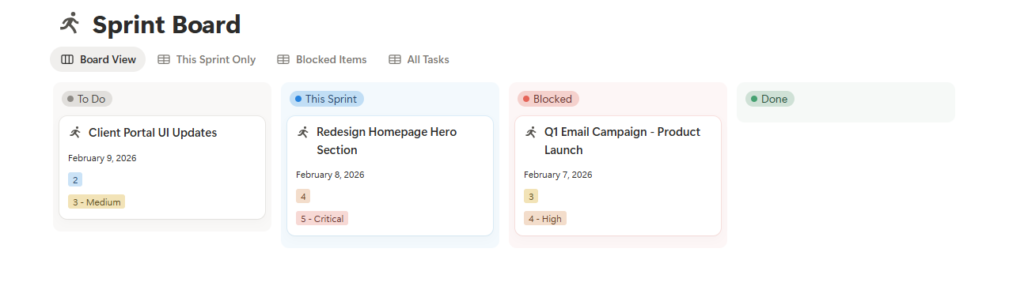
The Workflow Breakdown
1. THE BACKLOG (The Parking Lot)
“If it is not in the Sprint, it does not exist.”
This column is your shield against cognitive overload. It functions as the comprehensive holding area for every request, idea, or mandate that comes your way.
The Purpose: It captures everything so you don’t have to hold it in your head.
The Rule: Do not work out of this column. Working from the backlog creates a false sense of urgency. This column is for storage and triage only.
The Mindset: Put it here to “park” it. If it’s truly urgent, it will earn a spot in the next Sprint.
2. THIS SPRINT (The Commitment)
“5 Items. 5 Days. No Exceptions.”
This is the sacred space of the board. This column represents your capacity for the week.
The Purpose: To force prioritization. By limiting this column to 5 items, you are forced to make hard decisions about what actually matters right now.
The Constraint: If a 6th urgent item arrives, one of the existing 5 must move back to the Backlog.
The Mindset: This is a promise. Items in this column are not “intentions”; they are commitments to ship.
3. BLOCKED (The Red Flag)
“Not your fault, but your problem to chase.”
Work rarely happens in a vacuum. This column visualizes the friction points where your momentum has stopped due to external factors (waiting on a signature, a design asset, or budget approval).
The Purpose: To make invisible delays visible. A task sitting in “Sprint” that isn’t moving looks like procrastination. A task sitting in “Blocked” signals a dependency issue.
The Action: Your job changes here. You are no longer “executing” the task; you are “managing” the blockage. You are the squeaky wheel.
The Mindset: Do not let blocked items rot. Chase them daily.
4. DONE (The Velocity Log)
“The Definition of Done.”
The trophy room. However, this column has a strict bouncer at the door.
The Purpose: To track velocity and celebrate progress.
The Rule: An item effectively lands here ONLY when the “Definition of Done” (DoD) is met. This means no “it’s basically finished” or “I just need to email it.” If it isn’t 100% complete and off your plate, it stays in the Sprint column.
The Mindset: Completion is binary. It is either done, or it isn’t.
Why This System Works
1. It enforces WIP (Work In Progress) Limits By capping the Sprint column at 5 items, this system prevents context switching. Multitasking is a myth that destroys productivity; this board forces single-tasking focus.
2. It Externalizes Stress The Blocked column is a psychological tool. It separates your performance from external bottlenecks, reducing anxiety while keeping you accountable for following up.
3. It Protects Your Time The strict entry rules for the Backlog give you permission to say, “I’ve added that to the Backlog,” which is a polite way of saying, “I am not doing that right now.”
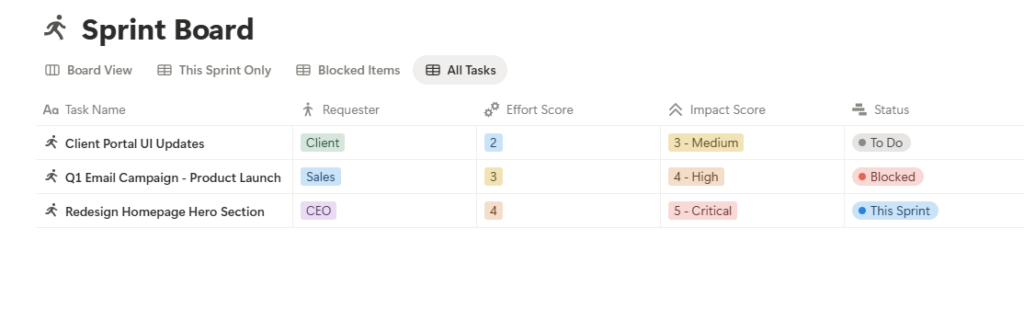
This tool is just one asset. Get the full system.
Marketing careers do not stall because of a lack of effort. They stall because of a structural flaw in how we work.
To move from the “Frozen Middle” to the C-Suite, you must transition through three distinct stages of value creation. This toolkit provides the specific operational assets to master each stage.
Includes:
🚀 The “Sprint Zero” Dashboard: Project Management Template
⚖️ The Negotiator Calculator
📂 The Delegation Scripts
⏱️ The 15-Minute Standup: Meeting Protocol
🛡️ The Eisenhower Matrix: Prioritization Framework